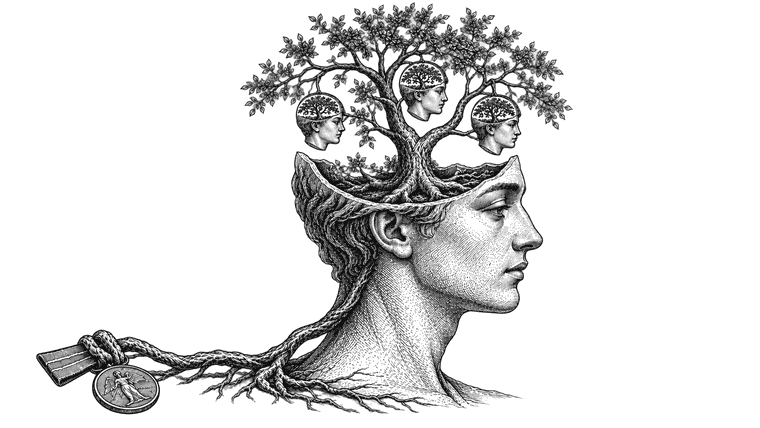
In Game of Thrones, almost nobody dies because they are weak. They die because they guessed wrong about someone else.
Ned Stark is the clearest case. He finds out the queen's secret, walks up to her, and tells her what he knows. In his head the next step is obvious: she will take her children and run. She does not run. A few episodes later he loses his head [1].
Ned knew the facts. What he got wrong was Cersei. He predicted her next move using his own values, not hers.
Littlefinger is the opposite. Seasons later he tells Sansa how he survives: fight every battle in your mind first, treat everyone as both friend and enemy, play out every chain of events, and then nothing that happens will surprise you [1].
I think that speech is the best plain description of a research idea I have been reading about for the last few weeks. It is called a social world model. I come from speech and NLP, and it took me a while to get it, so this post goes slowly, one piece at a time.
First, a plain world model
The idea is old. In 1943 the psychologist Kenneth Craik suggested that a mind carries a small model of the outside world, and uses it to try things out before doing them for real [2].
In machine learning a world model is one function. You give it the situation now and an action, and it tells you the situation next:
T(state, action) → next state
If you work with language models, you already know this shape. A language model takes the text so far and predicts the next token. A world model takes the world so far and predicts the next world. In 2018 Ha and Schmidhuber trained an agent that learned such a model for a car racing game, and then practised inside its own “dream” of the game [3]. Yann LeCun has argued that this kind of prediction is the missing piece for machines that plan [4].
There is one catch. The agent never sees the whole state. It sees a part of it, through a camera or a microphone, and has to guess the rest.
Speech people know this very well. In a hidden Markov model, the real state is hidden and you only get noisy sound [5]. The planning version of the same idea is called a POMDP. The agent keeps a belief, which is its best guess about the hidden state, and updates it after every observation [6]. So even a simple world model has two layers: what is true, and what I think is true.
Now put people in it
A racing game does not have opinions. A room with two people in it does. The most important parts of the state are now inside their heads, and you can never observe them directly. You only see what people say and do.
Tracking what someone else believes and wants is called theory of mind [7]. The classic test is about a marble, and it is easier to play it than to read about it [8].
try it: where is the marble?
step 1 of 4
Sally puts her marble in the basket. Anne watches.
The world
where the marble really is
Sally's belief
she is in the room
Anne's belief
she saw everything
Anne's guess about Sally
a belief about a belief
Look at the last row. Anne holds a belief about Sally's belief. That is first-order theory of mind. If Sally had peeked through the window without Anne noticing, Anne would now be wrong about Sally, and we would need one more level. Game of Thrones runs on these levels. Half the plot is someone knowing that someone else does not know that they know.
So a social world model is a world model where the state includes the minds: what each person believes, what they want, what they are paying attention to, and what they think about each other. The transition function has the same shape as before. It just has to predict how minds change, not only where marbles go.
Someone already wrote it down
The name comes from a 2025 paper from Carnegie Mellon and NVIDIA [9]. Their point is simple. Language models read social situations as free text, and free text hides who saw what. So they rewrite each moment of a story in a fixed structure: the state of the world, what each agent observes, what each agent does, and the mental state of each agent, written out explicitly.
With that structure in place, models do better at social reasoning. The paper reports a 51 percent improvement on FANToM [10], a benchmark of conversations where people join and leave so not everyone hears everything. It also reports up to 18 percent on SOTOPIA [11], where agents role-play social goals like negotiating or keeping a secret.
That convinced me the structure matters. But while reading it I kept asking a question the structure does not answer. It tells you what someone believes. It does not tell you why.
Why does he believe it?
Everyone knows the boy who cried wolf. A bored shepherd boy shouts “Wolf!” for fun, and the whole village runs up the hill to help. He does it again, and they come again. The third time the wolf is real. He shouts the same word, just as loudly, and nobody comes [12].
Look at it from the side of the villagers. The evidence on day three is exactly the evidence on day one: one boy, one word. What changed is how much that boy is worth as a source. The same sentence moved a whole village the first time and moved nobody the last time.
It works in the other direction too. If a stranger on a bus tells you to stop eating something, you shrug. If your doctor says the same sentence, you stop. A belief does not get its strength only from the evidence. A lot of it comes from the source.
Now a case closer to the systems I work on. Two visitors stand in a history museum, and a guide tells them about a wartime event. The first visitor believes one detail very firmly, because his grandfather was there and told him. The second also believes it, but only because of something he read online. Now the guide shows both of them a document that says otherwise.
try it: how hard does the source pull?
A visitor is sure about one detail of the story. The guide shows a document that says otherwise.
belief starts at 90%
The rule behind this toy is one line. The belief moves toward the new evidence, and a strong source slows it down:
belief ← belief + rate × (1 − pull of the source) × (evidence − belief)
It is a toy, and real people are not this tidy. But it shows why a guide who knows only what each visitor believes will treat them the same, and a guide who also knows where the belief came from will not. With the grandson you slow down and show more. With the other visitor one document is enough.
Drawing a mind as a graph
This is the part I am exploring myself, so read it as a sketch. Nothing here is built or tested yet.
If the source of a belief matters, the state should store it. A table cannot do that well, but a graph can. Every belief is a node. Every source is a node too. Between them runs an edge, and I think of that edge as a rope:
- The thickness of the rope is how strongly the two things are tied.
- The colour is whether one supports the other or contradicts it.
- A dashed rope is something the agent inferred. A solid one is something it observed.
Each agent gets its own graph, because each agent has its own picture of the room. And inside one agent's graph sits a smaller graph for every other person. That is the theory of mind part: my sketch of your beliefs, with my guess about your ropes.
The transition function is then a set of edits to the graph. Here I borrow from neuroscience. In predictive coding, the brain keeps predicting its input and only passes along the part it got wrong [13]. A social world model can work the same way. Predict what the other person will say. If you were right, change nothing. If you were surprised, update only the nodes that caused the wrong prediction. Ned Stark's graph had one bad node in it, his model of Cersei, and it never got the chance to update.
What I like most is that you can read such a state. In a language model, a belief is spread over millions of numbers, and to test what it does you have to patch activations and watch the output change [14]. In a graph you can point at the node, cut one rope, run the next step again, and see what the agent now says. Every answer can be traced back to the beliefs and sources that produced it.
Why this matters once agents work together
In my last post I wrote about agents that pass thoughts to each other without words. A social world model answers a question that post left open: what should they send?
Not everything. If I already have a decent model of what you know, I can predict what will surprise you, and send only that. The same prediction error that updates my own graph also tells me which facts are worth a message. One recent paper trains agents with exactly this kind of hidden guess about the partner's beliefs and intent, and they interact better for it [15].
Littlefinger never tells anyone everything. He tells each person the one thing that changes what they do next. That is a terrible way to live, and a very efficient way to communicate.
Two honest warnings
First, the words. I have written “believes” and “wants” about software all the way through. That is shorthand for variables in a state. It is not a claim that anything in there feels or understands, and it is worth saying so out loud every time.
Second, the tests. Several studies found that models pass theory of mind tests using shortcuts, and fail when the story is changed in small ways that should not matter [16][17]. So a good score on a marble story proves little. The harder test is whether the model changes what it does, not whether it can answer a question about a belief.
So
A world model predicts what happens next. A social world model predicts what happens next when the things that matter are inside other heads. To do that well it has to keep three things: what is true, what each person thinks is true, and why they think it.
Ned Stark had the first one. Littlefinger had the first two. The villagers in the fable were running the third without knowing it, and a good guide needs all three.
“You know nothing, Jon Snow” was never about facts. Jon knew plenty of facts. He did not know how the people beyond the Wall saw the world. Most of our agents are still in the same place.