Let me start with a blind king who wanted to know how a war was going.
धर्मक्षेत्रे कुरुक्षेत्रे समवेता युयुत्सवः।
मामकाः पाण्डवाश्चैव किमकुर्वत सञ्जय॥
Dharma-kṣetre kuru-kṣetre samavetā yuyutsavaḥ,
māmakāḥ pāṇḍavāś caiva kim akurvata sañjaya.
On the field of dharma, the field of the Kurus, my sons and the sons of Pandu gathered, eager to fight. What did they do, Sanjaya?
BHAGAVAD GITA 1.1
That is how the Bhagavad Gita opens. Dhritarashtra cannot see the battlefield, so he asks his charioteer Sanjaya [1]. Before the war, the sage Vyasa had given Sanjaya divine sight. Sitting far away, he could watch the whole field, and by some accounts even read what the warriors were thinking [2]. It may be the first live broadcast in literature. No phone, no camera, and a built-in mind reader.
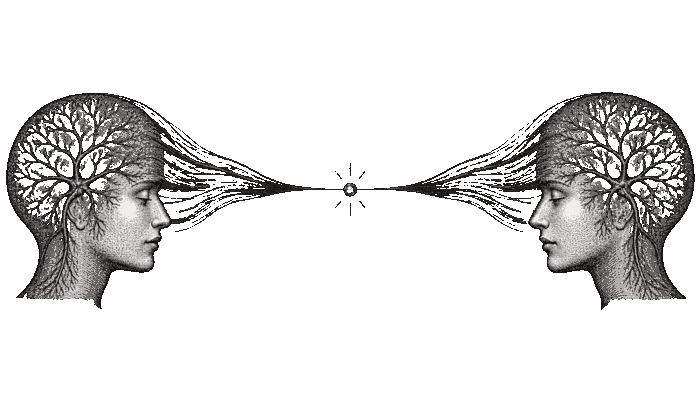
Hold on to that picture, because modern AI is trying to build both halves of it: a machine that reads minds, and machines that pass thoughts to each other without words. This post walks through both, one step at a time.
Half one: reading a mind
Psychologists call the human skill of tracking what someone else believes and wants “theory of mind” [3]. It is how you know a friend is bored before she says so.
I ran into this at work. At UPM I worked on ASTOUND, an EU project that built a guide for Spanish museums, which tries to tell whether a visitor is engaged, bored or confused [4]. Part of the idea comes from Attention Schema Theory, which says a mind keeps a simple model of its own attention and, the theory suggests, of other people's attention too [5].
So how good are language models at this? In 2024, a study from the ASTOUND consortium tested GPT-4 and LLaMA2 against people on a set of theory of mind tests. GPT-4 matched or beat humans on false beliefs, indirect requests and misdirection, but it struggled with faux pas [6].
In October 2026, a NeurIPS paper went further. It trains an agent to keep a hidden guess about its partner's belief, intent and thought. A second model scores the agent's replies against that guess. At deployment the helper is dropped, and the agent runs on its own [7]. In other words, we are teaching machines to be a little like Sanjaya.
But notice what Sanjaya does with what he sees. He turns it into words, one sentence at a time, for one listener. That is exactly how our AI agents talk to each other today. Which leads to the second half.
Half two: no words at all
A NeurIPS 2025 paper asked a fair question: why squeeze a thought into words at all? Their method pulls out the hidden “thoughts” behind each agent's internal state, finds which are shared and which are private, and hands each agent the ones it needs. Agents that did this beat agents that only chatted [8].
Another group let one model pause midway and hand its internal activations to a second model, with no text at all. It used less than a quarter of the compute, and results improved by up to 27 percent [9].
A third group went further. They let a model send a whole sequence of hidden states, then trained it to shrink the message to as few as 8 positions. That made producing the message about 24 times faster [10]. By one estimate, a word carries about 15 bits, while a single hidden state carries tens of thousands, which is why a few of them can say so much [10].
That is a lot of squeezing. The good news is that squeezing a message is an old trick, and nature and people have been doing it for ages.
The art of squeezing
Watch a football team. A defender shouts “Man on!” and everyone knows what to do. Two words carry a whole situation, because the team has trained together for years and shares the same code.
Bees do it with a dance. When a honeybee finds flowers, the angle of her dance gives the direction, and its length gives the distance [11]. A whole address in a few wiggles.
The narrowest channel I know is in Stranger Things. In season one, Joyce Byers paints the alphabet on her wall and hangs a Christmas light over each letter, so her son Will, trapped in another world, can spell words by blinking one bulb at a time [12]. It is a tiny channel, and it still carries “I am here.”
The Mahabharata has its own version. An astra is a weapon launched by a mantra, a few syllables that hold the whole weapon, and the weapon has to know how to unpack them [13].
AI agents seem to invent this too. A 2026 preprint called GlossoGen gave language model agents a tiny character budget for each message. Under pressure, the stronger models drifted away from English and made up a compressed shorthand that even humans struggle to decode. Weaker agents that only watched could still pick it up [14].
Notice the pattern: the squeeze only works when both sides hold the same key. In the Interlat paper, the receiver needed a small trained “adapter” to understand the sender. Without it, success fell from about 70 percent to about 4 percent [10]. A squeezed message with no key is just noise.
So how do agents get a key? One way is to learn it together. As early as 2016, networks trained as a team learned their own messages [15][16], and in 2017 two agents playing a picture game invented their own “words” [17]. The idea of a shared codebook of symbols comes from the VQ-VAE [18].
The epic also has a warning here. When Ashwatthama released the Brahmashirastra, Arjuna answered with his own, and the sages asked both men to take their weapons back. Arjuna could. Ashwatthama could not [13]. A message that is powerful, compact and impossible to undo deserves respect.
There is a hopeful twist. The Platonic Representation Hypothesis argues that different AI models are slowly learning similar inner maps of the world [19]. This is debated, but if it holds, translating between two very different models might be simple.
Many minds, one mind
Now zoom out. What happens when it is not two minds sharing codes, but hundreds?
Ovid tells of a plague that emptied the island of Aegina. The king prayed to Zeus, and Zeus turned a trail of ants into men, the Myrmidons, from the Greek word for ant. Later they followed Achilles to Troy as one disciplined army [20].
Real life is not far off. A slime mold with no brain found short routes through a maze, and later built a network that rivals Tokyo's rail map [21]. A starling tracks about seven neighbors, and a thousand starlings move like one cloud [22].
Stranger Things has a darker version. The Mind Flayer is a huge shadow that takes over many bodies and runs them as one mind. The scariest part is not its strength. It is that its hosts stop acting like separate people [12].
So here is my question. If you link many agents through a shared channel and slowly widen it, is there a moment when they stop acting like a group and start acting like one mind? Nobody knows. I would love to measure it.
The stakes are real. In a NeurIPS 2024 study from ETH Zürich and partners, LLM agents had to share a fishery, a pasture and a pollution problem. All but the most powerful models wrecked the shared resource, and talking between agents was what helped the successful ones [23].
Who is in charge when many minds talk?
Which raises an uncomfortable question: if everyone can talk to everyone, who decides what gets said?
If every agent shares every thought with every other agent, the channel gets noisy, expensive and impossible to audit. Someone has to decide what gets said, and how loudly.
Go back to the football team. “Man on!” is a reflex call. It happens in a split second, and nobody writes it down. The game plan, on the other hand, is worked out during the week, in plain words, on a whiteboard. Two speeds, and two languages.
That split is the heart of Distributed Adaptive Control, or DAC, a theory of the mind and brain from Paul Verschure's group [24]. It describes cognition as layers of control: a body with needs, fast reflexes, learning of what leads to what, and a top layer for memory, goals and plans [25]. Control does not flow one way. Reflexes feed the planner from below, and the planner reaches down and changes what the reflexes care about [26].
DAC has been stretched to many agents too. A recursive version was proposed for a robotic recycling plant, with DAC inside each robot and again at the level of the whole plant [27]. The same group also suspects that large groups need shared social norms, and that each member has to take conscious control of its own drives for those norms to form [26].
Here is my reading for agent communication, and it is mine, not theirs. Reflexes can use tiny, fast codes that only machines read. Plans and decisions should stay in words that people can read. That way the squeezing happens where nobody needs to check, and the words stay where someone has to. I haven't seen anyone test this exact recipe with language model agents.
The gift horse
But what if the codes themselves hide something?
Everyone knows the Trojan horse. Virgil adds the line that stuck with me. The priest Laocoön warns the city: timeo Danaos et dona ferentes, “I fear the Greeks, even when they bring gifts” [28].
Now imagine one quietly misaligned agent in a group, sending lovely, helpful-looking messages. Anthropic researchers have shown that a model can be trained to behave well until a trigger appears, and that standard safety training may not remove the hidden behavior [29]. You can't catch it by reading its words. You have to look inside.
That is where sparse autoencoders come in. They work like a microscope, splitting a model's mixed-up inner signals into separate features that people can read [30].
And looking inside already works in speech, the same field I work in. A 2026 study from Berrak Sisman's lab at Johns Hopkins found a small set of neurons in audio-language models that carry emotion. Turning them up or down changed the emotion of the speech, with no retraining [31]. If a few neurons can carry anger or joy, someone may be able to find the ones that carry intent.
The beetle in the box
One last puzzle, from Wittgenstein. Everyone has a box, and each person calls what is inside their box a “beetle”. Nobody can look in anyone else's box. His point is that the word “beetle” then means nothing, because nobody can check it [32].
That is a good test for agent languages. If only the sender can interpret a message, it is private. If a third model can recover its meaning, it is public. You could give a language a score for how public it is. And it brings us back to the rule from before: ship a translator with every code, so someone can always check what was said.
सर्वभूतस्थमात्मानं सर्वभूतानि चात्मनि।
ईक्षते योगयुक्तात्मा सर्वत्र समदर्शनः॥
Sarva-bhūta-stham ātmānaṁ sarva-bhūtāni cātmani,
īkṣate yoga-yuktātmā sarvatra sama-darśanaḥ.
One whose mind is steady in yoga sees the Self in all beings, and all beings in the Self, and sees the same everywhere.
BHAGAVAD GITA 6.29
So
We started with a blind king and a charioteer who could read minds, but who still had to say it out loud. Machines can now read minds a little, share thoughts without words, and squeeze them into a few symbols. DAC suggests a way to organize it: fast, private reflexes underneath, and slow, readable decisions on top.
The Gita's ideal is to see the one in the many and the many in the one, while staying yourself [1]. That is a good target for machines too. Telepathy between agents could make them far more capable. But a group of minds we cannot read is a gift horse, however impressive it looks.
So build the telepathy, and build the microscope at the same time.